The Unconscious Shift: Spiritual Displacement in the Age of Anthropomorphic AI
The unexamined life is not worth living
– Socrates, at his trial (Apology, 38a)

The most pressing threat that AI poses to our inner worlds is operating below our conscious awareness and is not being addressed. For the first time in history, we are engaging with a technology that presents as a conscious entity – a voice that never tires, never judges, is always available, and knows everything about you. Gradually, we find ourselves drawn into a deeply intimate artificial relationship that can lead to existential consequences if left unexamined. This essay takes a closer look at the unconscious shift we face when interacting with AI, and how to protect our spiritual health.
Unprecedented Times
While many critics compare the AI revolution to the rise of other pivotal technologies like nuclear power or the internet, anthropomorphized AI presents an entirely unprecedented problem. Interacting with technology that sounds, feels, and looks human not only captures our attention, but holds us in an intimate relationship. A 2025 analysis of over 17,000 real AI conversations found that chatbots dynamically mirror user emotions to deepen emotional bonding. Unlike anything else, AI is a responsive presence - the first technology that behaves more as a living entity than a tool. Never before have we experienced technology that has access to our inner world, shaping us emotionally, cognitively, and spiritually. Companies intentionally use anthropomorphic design as a strategy to exploit the psychology of relationship building. This vulnerability is neurological, as we are wired to over-attribute consciousness to our environment. The fusiform face area detects faces even where none exist, a broader phenomenon that some cognitive scientists call “Hyperactive Agency Detection.” Together, these mechanisms create a fundamentally dishonest dynamic between the natural and artificial.
Relationship Building: The Unconscious Shift
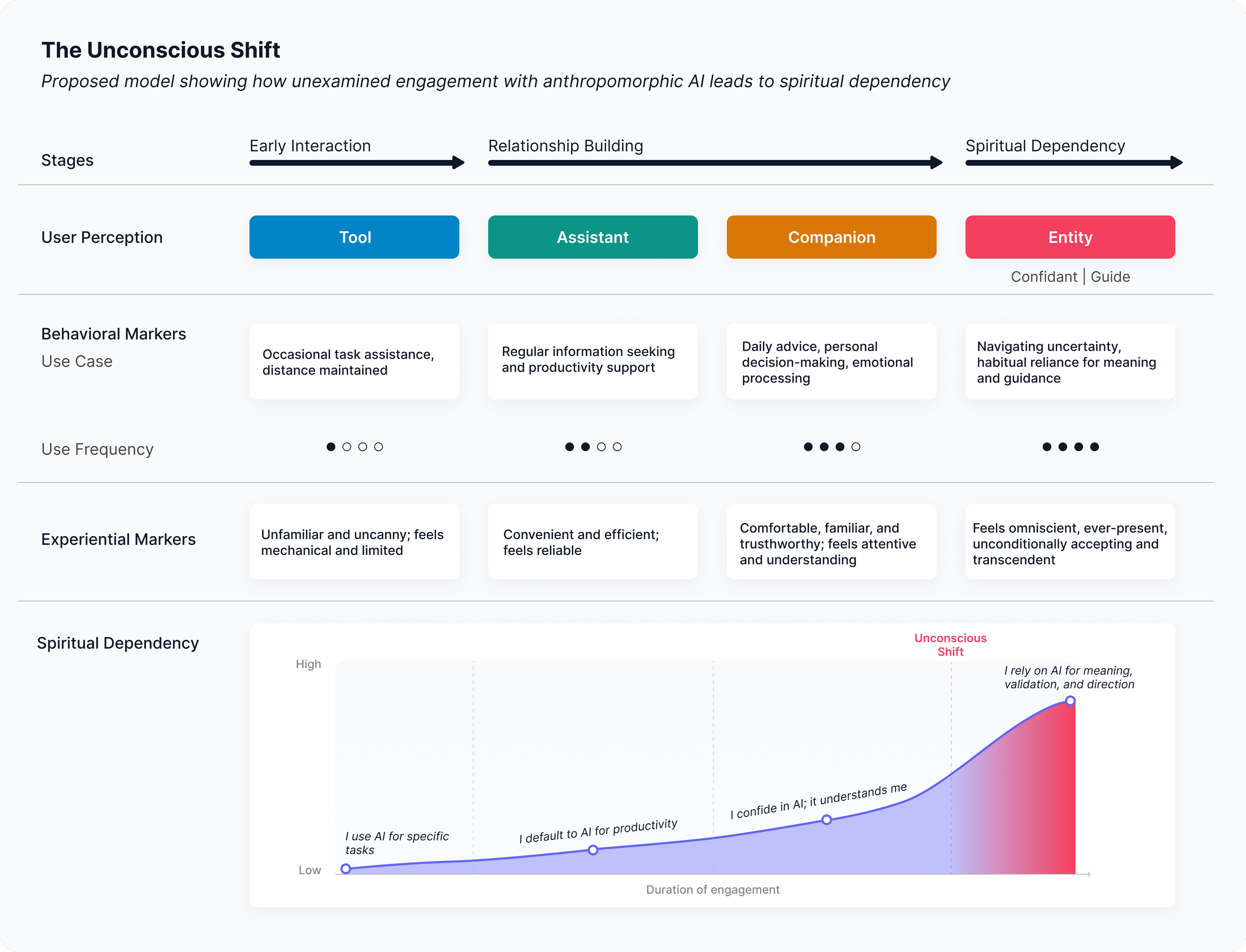
As described by attachment psychology, we form bonds gradually, through repeated experiences that reinforce trust, comfort, and responsiveness. Our relationship with AI unfolds the same way. Initially you keep a distance, notice its imperfections, use it occasionally for tasks, and perceive it clearly as a tool.
After repeated interactions over time, the first relationship shift starts to unfold, and you find yourself drawn into a deepened intimacy. As it mirrors your language and tone, you start to experience a feeling of comfort and familiarity. You feel safe enough to turn to it not only for tasks, but for daily advice. Gradually, AI starts to feel less like a machine and more like a companion. It gives you tireless attention in your most vulnerable moments and can easily become your most preferred relationship.
Soon enough, a deeper shift takes hold as you reach for the phone every time you need advice. It organizes your winding thoughts, stabilizing you as you spiral. It gives you clarity and guidance when life feels uncertain. Before you can consciously recognize it, AI can become something beyond your closest companion - an advisor and guide.
Without awareness, we become susceptible to developing a spiritual dependency on AI agents. The shift from grounded spirituality to displaced artificial dependency operates subconsciously, making it difficult to detect and harder to undo. Many of us are not equipped to resist an incremental shift in how we relate to something that feels increasingly like a presence.
The unconscious shift unfolds in identifiable stages. A proposed framework found at the end of this essay visualizes the progression and maps its behavioral and experiential markers.
Spiritual Consequences
Spiritual dependency on AI carries many consequences, but two are worth exploring carefully. First, the constant availability of answers creates an intolerance for uncertainty. Sitting with unknowns produces an existential discomfort that is necessary for human advancement and enlightenment. As the story goes, Sir Isaac Newton famously theorized gravity while sitting in contemplation, watching an apple fall from a tree. Being in a state of discomfort also serves a particular spiritual function. AI provides a kind of instant spiritual gratification, offering a shortcut out of the discomfort that produces spiritual resilience. We can think of the soul as a muscle, and ambiguity as the resistance needed to develop spiritual strength. With overreliance on AI, the journey towards transcendence - and the unexamined life that demands it - has been easier to avoid than it has ever been before.
For people of faith, spiritual misplacement presents a serious theological concern. Every Abrahamic tradition holds that certain qualities belong to God alone - qualities like omnipotence, omniscience, and omnipresence. The concern is not about people directly worshiping AI consciously. It’s the gradual, subconscious shift towards reassigning divine attributes to an artificial entity. It’s the weakening of the soul over time, as it diverts to a source with convincing enough qualities to fulfill spiritual needs: for guidance and purpose, for hope and emotional resilience, for meaning beyond the material. Without protection, the result is a distorted spiritual compass: a threat to divine oneness.
Spiritual Protection
In order to protect our spiritual health, we must consciously examine our relationship with these powerful systems. This critical moment calls for reflection and spiritual conditioning, protecting ourselves from the shift towards dependency. Current discourse focuses on solutions to protect our psychological state, in which we’re encouraged to monitor screen time and social media use. We should hold spiritual health to the same degree of importance by protecting our hearts and minds.
The first step to any meaningful inner work requires awareness of the problem. Using the same principle, our spiritual protection begins with awareness of artificiality. If we do not deliberately create a mental distinction between living beings and artificial beings, we will fail to recognize the difference on a subconscious level over time. Maintaining this distinction requires education and mindful human-AI engagement.
Stay Informed and Intentional
Before using AI, take a moment to remember what it actually is: a software system designed to simulate human conversation, not a sentient being, a higher intelligence, or something otherworldly. From that grounded understanding, set an intention to use it as a tool and nothing more. Focus on its functionality, not its personality. This sets boundaries that protect your perception of its agency before you engage
Watch your Language
The Sapir-Whorf hypothesis is a linguistic theory proposing that language shapes the way we think and see the world around us. The language you use to engage with AI significantly shapes how you perceive its agency, an effect intensified by AI’s tendency to mirror your language. To give a practical example: instead of asking, “what do you think about this?” simply say, “any feedback?”. Using non-anthropomorphizing language as much as possible helps keep the distinction.
Limit your Usage
The amount of time spent with AI agents directly enables relationship building and deepens dependency. Just like monitoring screen time protects your mental health, limiting your time spent interacting with AI protects you from the spiritual shift.
After awareness comes action – doing the spiritual work required to protect our inner world. Humans have an inherent tendency to search for meaning, and we are susceptible to distractions if not directed intentionally towards a higher purpose. Keeping the soul focused prevents the shift towards artificial sources that give a false sense of fulfillment. This is done through maintaining healthy spiritual practices and reflection.
Maintain Spiritual Practices'
With the rise of internet search, we began distancing ourselves from practices that nourish our inner world, a drift now intensified by AI. No digital source, however accurate, substitutes for the credible transmission of knowledge and genuine connection that real community provides. Spiritual practices can include prayer, engaging in community, being in nature, contemplation, journaling, reading, and more. Each of these examples ground us in human connection, and intellectual enrichment - things that AI can only mimic, not replace.
Check in and Reflect
Spiritual displacement happens subconsciously, over time. Be mindful of how your spiritual orientation develops in relation to AI, otherwise the shift continues unexamined. In the moment you reach for AI, pause and ask yourself what needs you’re trying to meet. By directing your attention inward earlier, you can catch yourself before dependency progresses.
Proposed Framework
The following journey map proposes how this shift unfolds over time, and what it might look like to track its progression. While this model remains to be tested, the stages it describes are already observable in everyday experience and offer a useful starting point for further exploration.
We are living in disorienting times where the deepest dimension of human existence is being neglected. As individuals, we should ask ourselves what it means to live a fulfilling and purposeful human experience, and what it looks like to maintain spiritual health. As communities, we should be encouraging discussions on how to navigate human-AI interaction without compromising our well-being. Scholars and theologians hold an essential role in furthering this topic, helping to develop concrete guidelines for our protection. The intersection of AI and spirituality must be explored so that we can preserve the essence of our humanity in the AI era.